Middlesbrough AFC: Dan Prince (Club Journalist)
Dressing up defeat is one of the hardest parts of a Club Journalist’s role with even Dan Prince (who has 12 years in the industry), claiming it’s extremely difficult” but you have to “choose” your moment.
“Yeah, it can be extremely difficult, and you’ve got to try and find the right balance, and I think it’s about experience really.
“Especially with the club I’m at now, we’ve obviously got a strong media team, and we’ll discuss the defeat together and how we will create content despite the result.”
“We won’t be going off on our own tangents. We’ll discuss how to respond to it together.”
“But in general, it’s just about reading the room. So, if you’ve got lighthearted pieces of content that you want to push out, you pick and choose your moments – you wouldn’t do it after a four-nil defeat and you wouldn’t do it in the middle of a bad run of form.”
“If we wait two or three weeks, hopefully the tide will turn a little bit, and then that might be a better time to put that certain content.”
“Yeah, you want to get that content out there, but pick and choose your moments in the right way.”
South Shields FC: Sam Jones (Media Officer)

Image Credit: Kev Wilson 📸
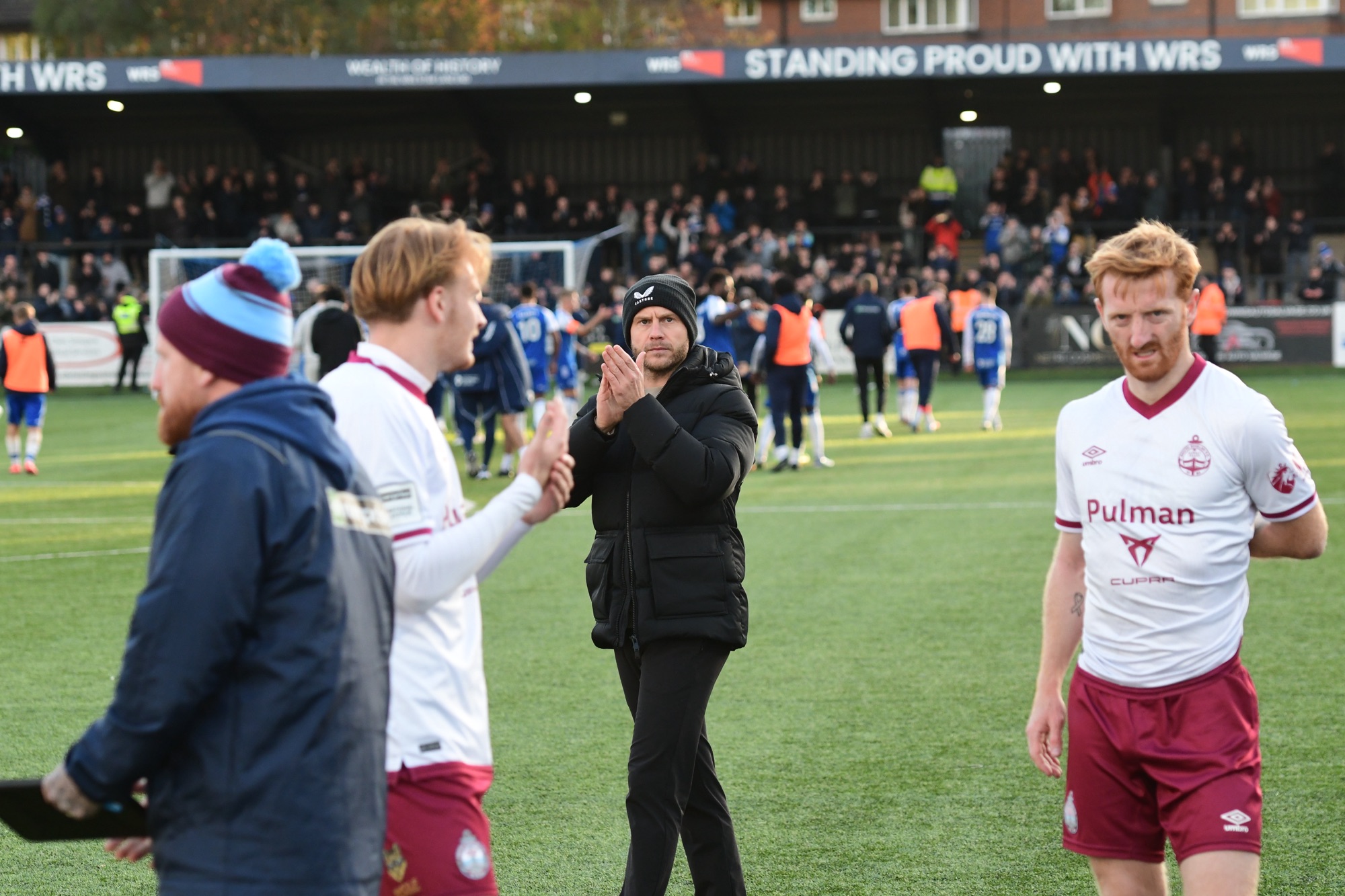
Ian Watson after South Shields defeat to Macclesfield FC
“When we lost our 1st league game of the season to Macclesfield it did take the wind out of me and definitely the content, because you are used to shelling out as much content as possible from the win, and like I say if you can’t dish out this “winning content” it’s much harder.”
“Effectively in our job, when the whistle blows for full-time we keep going.
“But when you lose you can’t really create a lot because the wind is taken out of you, it’s flat.”
“You can do interviews post-match but the usual winning content obviously can’t be created.”
Burnley FC: Alex Waters (Content Producer)
Creating content with the club when they are not performing well on the pitch can get quite difficult as Alex said: “In terms of when results are not going our way, it’s not a case of no one wants to do anything, but getting that access to players does become more difficult.”
“Because under some circumstances the manager could rightly say no we don’t want to do that we need our players focussed and training hard.”
“The results do impact what you can and can’t put out.
“Obviously you can’t post humorous content when you’re losing games.”
“But we still have our job to do, which is to post creative content.”
Everton FC: Ross Hughes (Content Producer)
“Unfortunately I do have experience with creating content around bad results. What we usually do is kind of try and spin it on the focus is on training hard. The fun content we just won’t do. Because fans will be on the same wavelength that the players should be back at work.
“So we accept the loss and get onto creating content that shows us preparing hard, accepting the defeat but showcasing that the players are hard at work for the next game.”
“The impact fans have is absolutely massive. That’s why then, it is so important to keep them on board creating this sort of content when results aren’t going your way.”
Carlisle United: James Gates (Marketing & Media Officer)
Similar to the Club Journalists I have spoken to throughout my time creating the website, James Gates too, touched upon the difficulties of dressing up defeat, however specifically mentioning how you become “aware of timing.”
“After a defeat especially, you’ve got to be careful. Sometimes less is more. It’s about understanding what’s appropriate to put out and when.”
“You become quite aware of timing — not just what you’re posting, but when you’re posting it.”
“After a loss, it’s usually just about getting the key bits out — manager interview, player interview — the basics — and then letting things settle a bit rather than forcing loads of content.”
“On the flip side, after a win it can be completely different. You can be there for hours after full-time just getting everything out and scheduled because there’s so much good content to work through.”
Shrewsbury Town: Jonny Drake (Club Journalist)
“It’s all about managing expectations. It’s managing your audience. For example we will go to training every Monday or Tuesday after you win. But we won’t go or even consider it after a loss.”
“Another example is, say for instance – you’re 21st in the league and you lose two games, you obviously won’t be posting certain stuff which can be deemed a distraction.”
“So it’s all about managing your audience.”
“What’s good to know as a Journalist in our job, is being aware of what content you post too, thinking about each word and the caption and what is relevant to what the result is.”
“Like you don’t want to post something that has a word or caption that will create controversy or even allow the fans to think that isn’t right, for example off the back of a defeat.”
“You want to dress it up in a way that everybody is happy or at least neutral about the content despite the result.”
“I think if you do this, people do really appreciate this consistency and reliability.”
“Because there’s a lot of pressure on the players and on people in football.
“So you’ve got thousands of people every week who can get very angry with you if stuff doesn’t get a plan and you then go ahead and post certain types of content.”
Aston Villa FC: Lewis Redmond (Club Journalist)
“One of the best things I have learnt on this journey was something that Aston Villa’s Lewis Redmond told me which was, in terms of creating content when faced against defeat, “less is more.”
“In terms of dressing up negative news I’ve found the more experience I have had in the industry I have learnt that less is often more.”
“So for example you don’t want to be posting lots of content and specifically content that is fun or could antagonise fans, you don’t want to make it seem all happy and rosy, when the team is on a losing streak.”
“So overall the idea is that when you are losing games you don’t want to give them content they don’t want to consume because of the results. And that’s where quality comes before quantity.”